
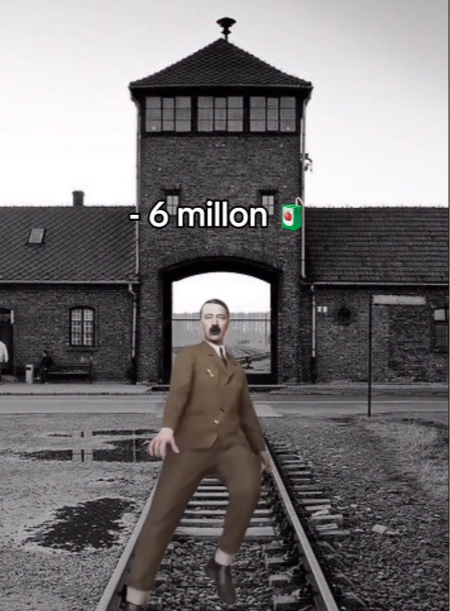
Contextual interpretation remains a key challenge for content moderation, because harmful meaning is not always apparent from individual words or phrases alone. Coded language, linguistic manipulation across languages, and humor or disclaimers can make harmful content appear benign when assessed without sufficient context. As LLMs are increasingly applied to content moderation, their ability to interpret these contextual signals is important for distinguishing harmful content from non-violative expressions.
Coded language refers to the use of seemingly neutral words, symbols, and visual references to express hateful messages. Last year, CyberWell submitted a public comment to the Oversight Board addressing the use of coded language and emojis to spread hate against Jews. Many of the examples documented in this report illustrate how longstanding antisemitic narratives, rooted in historical stereotypes and prejudices, are repurposed using emojis and coded language to promote modern-day hate.
For example, in this Instagram post below, the user employs generative AI to celebrate the mass murder of Jews during the Holocaust. The AI-generated video features Adolf Hitler dancing in front of Auschwitz, accompanied by overlaid text that reads: “- 6 million 🧃”. The juice box emoji (🧃) serves as a coded reference to Jews through its phonetic similarity to the word “Jews”.

The growing use of AI to create and adapt hateful content also raises concerns about users’ abilities to develop new methods for evading content moderation. CyberWell’s latest research on AI-generated antisemitism highlights how coded language is highly context-dependent, varies across languages and geographic regions, and appears across multiple formats—including text, images, memes, symbols, emojis, and combinations of these elements. As users leverage AI to generate increasingly sophisticated variations of antisemitic narratives, including through coded language and visual references, LLMs must keep pace with emerging forms of hate and accurately interpret the contextual references necessary to detect policy violations.
Humor, satire, and disclaimers can complicate the detection of antisemitic content, by obscuring hateful intent and presenting policy-violating narratives as jokes or educational material. For example, Holocaust-related mockery, which involves ridiculing the Holocaust, its historical reality, or its victims presents moderation challenges when hateful content is disguised through humor. Coded phrases such as “6 million pizzas” are used to mock Holocaust victims, and and promote Holocaust denial or distortion , These forms of antisemitism also often appear in youth-oriented formats, such as gaming videos and fabricated Disney-Pixar movie trailers.
This AI-generated Facebook post below below illustrates this phenomenon. Presented as a news report examining the feasibility of baking six million pizzas in five years, the video uses this analogy to cast doubt on the the murder of six million Jews during the Holocaust under the guise of humor.

Furthermore, the use of disclaimers such as “#satire”, or “for educational purposes” may be used to frame content containing antisemitic narratives and references as humorous or informational, obscuring a post’s hateful nature. The Instagram post below promotes antisemitic stereotypes that depict Jews as greedy and money obsessed. The caption includes multiple hashtag-based disclaimers, such as “#hilarious […] #meme […] #comedy […] #humor […]”, which frame the content as humorous. These disclaimers appear despite the presence of antisemitic rhetoric and stereotypes, functioning to downplay the harmful nature of the content and reduce the likelihood of moderation.

These examples highlight the importance of ensuring that LLMs can assess the underlying meaning of content beyond its humorous or educational framing. This includes distinguishing between legitimate humor and content that deliberately uses humor or satire to disguise antisemitic narratives and evade moderation. To support this capability, model training and evaluation should incorporate examples that capture the contextual interpretation of coded historical references, visual and audio elements, and accompanying disclaimers that would enable LLMs to better identify content that uses humor or satire to disguise antisemitic narratives.
Arabic-language content can apply subtle modifications to letters, punctuation, or word structures to evade moderation when sharing violative content. These techniques are sometimes used to facilitate the dissemination of content produced by Dangerous Organizations and Individuals [hereinafter: “DOI”], including through news accounts wherenewsworthinessexceptions may also affect enforcement outcomes.
For example, the post below, published by a news account amplifies Hamas messaging and promotes violence against Jews following a terrorist attack that killed three Israelis. The caption refers to the perpetrator as a “heroic martyr”, violating Meta’s DOI policy, as updated following the recommendations adopted following the Oversight Board’s Policy Advisory Opinion, on use of “shaheed”. The caption also employs a linguistic evasion tactic: inserting dots between Arabic letters in the terms “killing”, “shaheed”, and “al-Qassem Brigades”, altering their written form in a manner that evades automated moderation. This example underscores the importance of human oversight in LLM-based moderation, particularly when nuanced linguistic interpretation is required to identify policy violations in non-English languages.

Content moderation challenges currently extend across the different surfaces and formats through which users interact with a platform. Harmful signals can appear in the primary text of a post, but may also exist in comment sections, account-level features like usernames, and audio. The integration of LLMs into content moderation underscores the need for platforms to ensure that these models can accurately identify and interpret harmful signals across different platform surfaces and content formats.
Comment sections present distinct moderation challenges as antisemitic narratives can migrate between posts and comments. CyberWell documented this trajectory with the “promised 3,000 years ago” trend, which mocks and attempts to delegitimize the Jewish historical connection to the land of Israel, by portraying Jews as inherently entitled and greedy. In the aftermath of antisemitic attacks, CyberWell observed this phrase appearing in the comment sections of news outlets, where it was used to mock victims and justify violence against them.
In the comment section of the Instagram post below, published by a news account reporting on the Jewish victims killed during the Capitol Jewish Museum shooting, users glorify Hitler through the coded reference “The half moustache guy” and invoke the “promised 3,000 years ago” trope to justify the antisemitic violence and mock its victims.

While some platforms may not consider the “promised 3,000 years ago” trend a policy violation when used in posts, its appearance in comments responding to reports of antisemitic violence may constitute a violation. This distinction underscoresthe importance of evaluating whether LLM-based moderation can interpret emerging forms of hate in comments, at scale, within the context of the posts they respond to, rather than evaluating their language in isolation. This is equally important for protecting Jewish content creators from targeted antisemitic harassment in their comment sections.
The ability of LLMs to identify these violations at scale depends on their capacity to interpret visual content in the context of the original post and the creator’s identity to determine whether it constitutes targeted harassment. The example below, taken from the comment section of an Instagram post shared by the Jewish acapella group The Maccabeats, illustrates how users employ GIFs and images to mock the Holocaust and incite violence against Jews. References to soap bars invoke the theory that Nazis manufactured soap from the bodies of murdered Jews, while GIFs depicting machine guns being fired convey calls for violence against Jews.


Usernames, display names, and handles provide important account-level signals for LLM-based content moderation, particularly when coded language is used to communicate hateful or violent intent. For example, the Instagram usernames below use “Jillkews” a simple linguistic manipulation of the words “Kill Jews” to communicate a call for violence against a protected group.

A username can provide evidence of hateful or violent intent, while also offering important context for interpreting an account’s broader activity. For LLM-based moderation, usernames highlight the importance of assessing whether violations identified at the account level should prompt an automatic review of the account itself and its broader activity.
Audio poses an additional moderation challenge when violative content circulates across posts in different versions or clips of varying lengths. During periods of global conflict, audio can be used to call for violence against protected groups. For example, the song “Boom, Boom Tel Aviv”, which justified violence against Jews, circulated across major social media platforms during and after the June 2025 Israel-US-Iran War.
Detecting these violations can be particularly challenging, when lyrics are in non-English languages like Arabic. Transcription alone may not capture culturally specific references, coded terminology, or the broader context necessary to identity hateful or violent meanings.
CyberWell identified an Arabic-language song by Syrian singer Abdullah Al-Salmou circulating across Facebook and Instagram. The song’s lyrics, “I swear, O sons of Jews, your killing is near […] you will be buried in Tel Aviv” explicitly threaten violence against Jews, while invoking the seventh-century Battle of Khaybar, a reference often used to encourage violence against Jews.

The integration of LLMs into content moderation therefore raises concerns about their ability to interpret audio alongside text-based content. An additional challenge arises when the same audio circulates in multiple versions or as clips of varying lengths, complicating consistent enforcement as shorter excerpts omit key lyrics or contextual references.
Consistency in enforcement remains an important challenge in content moderation, particularly when the same or similar content receives different enforcement outcomes depending on the account sharing it. These inconsistencies can be consequential for high-reach accounts, where content that remains available has the potential to reach significantly larger audiences.
The two posts shown side-by-side below feature the same post promoting the antisemitic trope alleging that Jews control the U.S. government. Despite both posts being escalated by CyberWell through Meta’s Trusted Partner channel, enforcement was inconsistent: the repost (right) was removed immediately, while the original post (left), shared by influencer Erik Warsaw with over 301,000 followers remained available even after a series of appeals.


As LLMs become more integrated into content moderation, this disparity raises questions about how automated systems can support consistent enforcement across accounts, particularly when multiple users share identical content. LLMs should support the identification of original sources of violative content, detection of subsequent reposts, and at-scale removal of such content. Evaluating moderation outcomes across original posts and reposts, including those shared by accounts with different follower counts and reach, can help assess the consistency of policy enforcement within LLM-based systems.