

CyberWell’s research highlights that this recurrent pairing of denial and conspiratorial self-victimization does more than distort reality — it fuels real-world harm. Since October 7, these tropes have created echo chambers online that normalize antisemitism and dehumanization of Jews and Israelis, inciting further violence. This cycle of blaming Jews for crises while denying their victimhood when attacked is one of the more dangerous narrative trends observed in the current antisemitic discourse. Yet, platform policies rarely address it directly. As a result, antisemitic denial and conspiratorial self-victimization narratives remain overlooked, leaving a critical gap that allows this content to spread unchecked.
CyberWell’s analysis indicates that denial and conspiratorial self-victimization form part of a cycle that links online rhetoric with real-world danger:
In every violent incident examined in this dataset, at least the last three components occurred. The Amsterdam pogrom – a coordinated antisemitic attack on Israeli soccer fans in Amsterdam on November 7, 2024 – exemplified all four: It was organized and mobilized online, the violence was glorified, denial and conspiratorial self-victimization followed, and calls for further violence emerged in the lead-up to the Israel national team’s match in Paris a week later.
Anti-Israel demonstrations against the friendly match between the Israeli Maccabi Tel Aviv Football Club and Dutch football club AFC Ajax were organized online, but canceled by the municipality of Amsterdam to avoid clashes and tensions at the stadium and then moved by several of the organizing groups to a different location.
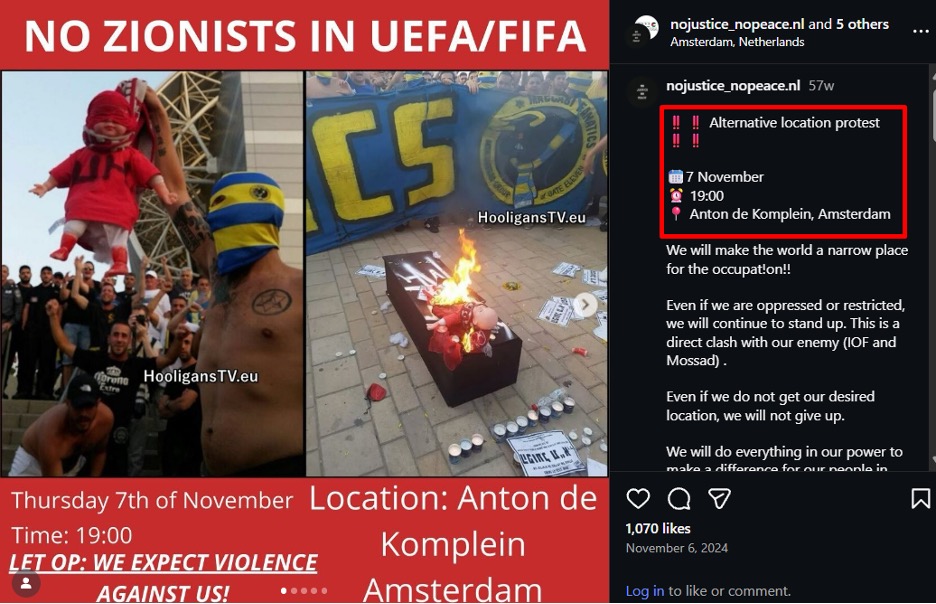
However, during the days leading up to the match – while Israeli fans stayed in Amsterdam – digital evidence indicates that the attacks in Amsterdam were preceded by planned coordination, with multiple reports indicating that much of the organization occurred on Telegram or WhatsApp, as seen in the images below:


Following the attacks, users engaged in online glorification of violence against Israeli victims. In the tweet below, the user refers to the victims as “filthy Jews” and praises those who carried out the attacks.

In this TikTok post, the speaker disputes the characterization of the November 7, 2024, antisemitic mob attack in Amsterdam as a pogrom. The speaker states: "[...] Only a couple days after the ADL said that I was antisemitic for not calling the football hooligan fight a, you know, a pogrom [...] Israeli mob violence in Amsterdam [...] false narrative insistently advanced by its own newspaper that the Israeli fans were victims of mob violence motivated by anti-Jewish hatred [...]" [00:15-02:43]. Alongside the video, the user adds the following description: “The so-called Amsterdam pogrom wasn’t actually a pogrom after all […]”.

Seven days later following the attacks, a soccer match was held in Paris between the French and Israeli national teams. Leading up to this event, CyberWell found that multiple users were already calling for further violence. Below is one example:

The Amsterdam pogrom thus exemplifies how antisemitic narratives evolve and reinforce one another across online spaces. Each stage of the cycle—mobilization, glorification, denial, and renewed incitement—builds upon the previous, sustaining a continuous feedback loop of hate. This incident underscores both the real-world impact of online antisemitism and the speed with which violent rhetoric can translate into physical harm and inspire further attacks.
CyberWell’s methodology is grounded in the IHRA Working Definition of Antisemitism. However, beyond IHRA’s specific focus on Holocaust-related denial, the IHRA definition does not reference broader denial or conspiratorial self-victimization narratives surrounding antisemitic violent attacks. In this context, only the fourth and fifth examples of the IHRA working definition (hereinafter, “IHRA Example 4”, “IHRA Example 5”) are directly relevant, as they focus solely on Holocaust denial and distortion:
Conspiratorial self-victimization, which is currently only addressed in the context of the Holocaust, remains outside of existing definitional frameworks. While the IHRA definition includes examples of scapegoating, these do not capture the specific dynamics of conspiratorial self-victimization.
The concept of scapegoating Jews is covered in the third example of the IHRA working definition (hereinafter, “IHRA Example 3”):
This pertains to collective blame for real or imagined wrongdoing, often in connection with major world events, disasters, and tragedies, rather than instances in which Jews are victims of a tragedy and are subsequently accused of fabricating it or causing it. In other words, IHRA Example 3 covers scapegoating, but not conspiratorial self-victimization.[8]
To address this gap, CyberWell developed a categorization system designed to specifically track and analyze these narratives. The following categories are labeled CyberWell 1-4 (hereinafter “CW1-4”) to distinguish them as part of CyberWell’s framework:

Notes:
- Many examples fall into more than one category simultaneously. For example, content labeling the October 7 massacre as a “hoax” (CW1) often appears alongside claims that Jews staged the attack for political gain (CW3).[9]
- These categories can also intersect with antisemitic narratives under the IHRA Working Definition of Antisemitism, where denial and conspiratorial self-victimization overlap with classic antisemitic tropes. Such narratives may incorporate broader conspiracy theories, reinforce antisemitic tropes, or rely on harmful generalizations. For instance, a user might blame Jews for a shooting against the Jewish community while concurrently claiming that all Jews are “Satanic”.
The specific overlaps and examples will be explored in detail throughout this report. To examine these patterns, CyberWell carried out a focused analysis, presented in the following section.
From November 7, 2024, to August 28, 2025, CyberWell examined antisemitic content that both denied violent attacks on Jews and Israelis and propagated conspiratorial self-victimization claims asserting that they orchestrated the attacks themselves. This start date was selected with intention. The Amsterdam pogrom that occurred that day marked a critical turning point as the first major act of antisemitic violence following October 7. Denial and conspiratorial self-victimization narratives once again dominated the discourse—a pattern consistently observed after each subsequent violent event. This moment demonstrated that October 7 was not an isolated case but the onset of a recurring trend. It also illustrated how such narratives can fuel further incitement, as evidenced by calls for violence at the Paris match the following week.
A total of 308 posts were verified as antisemitic, centered around these narratives, across five major platforms: Facebook, Instagram, TikTok, X, and YouTube. The content, in both English and Arabic, was collected using CyberWell’s methodology which includes AI-powered detection, keyword-based tracking, and manual review by trained analysts. Each post in the dataset was evaluated using CyberWell’s categorization of denial and conspiratorial self-victimization (CW) as well as the IHRA Working Definition of Antisemitism.
Across all collected posts, the discourse consistently revolved around the following violent attacks targeting Jews and/or Israelis:
Note: While some of these attacks occurred prior to November 7, 2024 — such as the 1994 London Israeli Embassy bombing — all posts included in this dataset were collected beginning on that date. This time frame was selected to analyze how denial and conspiratorial self-victimization narratives emerged and spread online after November 7, 2024, irrespective of when the original violent event took place.
A car bomb targeted the Israeli Embassy in London, injuring twenty civilians, followed by a second bomb outside Balfour House, a Jewish community building.
Hamas launched a large-scale terrorist attack in southern Israel, killing over a thousand people, namely civilians.
A violent mob targeted Israeli soccer fans in Amsterdam that lead to physical assault, multiple injuries, hospitalizations and a rescue flight.
The Adass Synagogue in Melbourne was deliberately set on fire in an arson attack, causing severe damage to the building.
Three buses were destroyed by onboard bombs, while two additional buses in the nearby city of Holon were found with identical devices that failed to detonate.
Cody Balmer set fire to Pennsylvania Governor Josh Shapiro’s official residence, reportedly motivated by personal hatred toward the governor and his “plans for Palestine”.
Two Israeli Embassy staff members were killed outside the Capital Jewish Museum in Washington, D.C., when a gunman opened fire during a “Young Diplomats Reception” hosted by the American Jewish Committee as they left the event.
An assailant attacked Jewish participants at a solidarity walk for Israeli hostages using a makeshift flamethrower and Molotov cocktails. The assault injured at least seven people, including the suspect, and an 82-year-old Holocaust survivor that later died from her injuries.
An assailant set fire to the front door of a centuries-old historic synagogue.
A Jewish man was brutally assaulted in Montreal in front of his children.
Jews attending an Israeli hostage vigil in Frankfurt were attacked with red paint.
The sample was distributed across platforms as follows, with percentages representing the share of total posts collected:

This distribution demonstrates the prevalence of antisemitic denial and conspiratorial self-victimization posts across social media platforms, with X alone accounting for half of all recorded posts. Additionally, engagement levels on X were notably high, representing 85.5% of total views and 64.3% of all interactions. These figures underscore X’s dominant role in amplifying such content online.
The dataset analyzed in this report reflects nearly 14 million views and over 500,000 user interactions.[10] This makes it CyberWell’s second most-viewed verified dataset behind the organization’s earlier study on denial and conspiratorial self-victimization related to the October 7 massacre. In that report, CyberWell analyzed posts which amassed over 25 million views within the first three months following that event. These findings reaffirm that denial and conspiratorial self-victimization remain among the most pervasive manifestations of antisemitism online.
Below is a breakdown of the total engagement observed:
Comments | 21,417
Likes | 408,016
Shares & Retweets[11] | 85,574
Views[12] | 13,759,094

These levels of engagement also highlight the urgency for platforms to detect and moderate violative content following violent events. Denial and conspiratorial self-victimization posts are often strategically framed as expressions of “skepticism”, enabling them to evade moderation and gain traction before detection. When left unaddressed, these narratives rapidly escalate, normalizing antisemitism and fueling real-world harm.
Additionally, U.S. events (the D.C. shooting and the Boulder attack) accounted for 35.4% of the dataset, yet drew 80.3% of views and 56% of engagement. This reflects how antisemitic narratives achieve disproportionate traction around U.S.-linked incidents. CyberWell’s assessment is that this pattern is driven by antisemitic influencers with large, primarily English-speaking audiences, who are more likely in a U.S. context to deny that antisemitic attacks occurred or to claim that Jews orchestrated attacks against themselves.
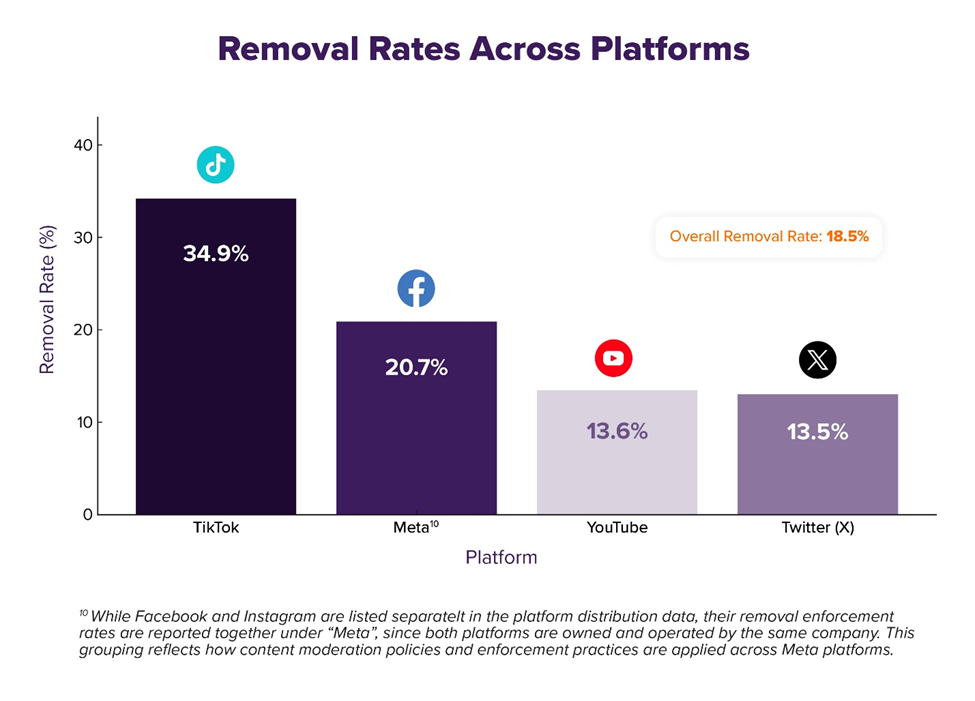
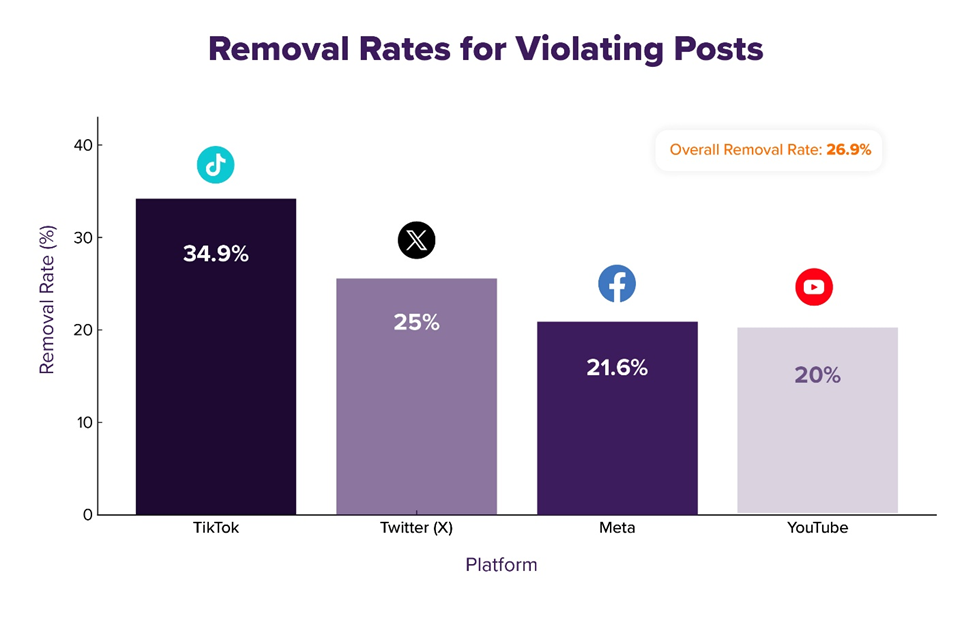
CyberWell analyzed the removal rates for all 308 posts in the dataset, including those identified as policy-violating, to evaluate how platforms address denial and conspiratorial self-victimization in the context of violent events targeting Jews and Israelis.
TikTok | 34.9%[13]
Meta (Facebook & Instagram)[14] | 20.7%
YouTube | 13.6%
X | 13.5%
Overall Removal Rate | 18.5%.
TikTok | 34.9%[15]
X | 25%
Meta (Facebook and Instagram) | 21.6%
YouTube | 20%
Overall Removal Rate | 26.9%.
Key Findings:
It is noteworthy that 47.4% of the 308 posts in the dataset focused on denial or conspiratorial self-victimization narratives surrounding October 7.
CyberWell analyzed removal rates for this content to assess how platforms enforce their policies when addressing one of the most extensively documented recent antisemitic atrocities – the deadliest day for Jews since the Holocaust. The findings reveal exceptionally low enforcement: the overall removal rate for October 7 denial and conspiratorial self-victimization content was only 17.8%, while the removal rate for denial alone was just 25.7%. These figures contrast sharply with CyberWell’s earlier monitoring, conducted ten months after October 7, in which a 36.4% removal rate was recorded for comparable denial content.
There are likely two main explanations for this gap:
1. Enforcement Timeframe:
In CyberWell’s earlier monitoring, platforms had a longer period to act on reported content before removal rates were assessed. In the current dataset, many posts were reviewed over a shorter timeframe – often only one to two weeks – leaving less time for enforcement actions to be reflected. Nevertheless, allowing harmful content to remain online for extended periods is unacceptable. Platforms must enforce their policies swiftly to prevent denial and conspiratorial self-victimization narratives from spreading and inflicting further harm.
2. Declining Moderation Over Time:
Platforms appear to have applied stricter enforcement in the immediate aftermath of October 7 but have since seemingly relaxed their approach. This erosion of moderation standards is deeply concerning. Denial of violent antisemitic events should be treated with the same zero-tolerance threshold as Holocaust denial, as both serve to erase Jewish victimhood and—particularly in the case of October 7—can perpetuate real-world harm. The difference lies primarily in platform policy. As documented in CyberWell’s Annual Report (2024), platforms explicitly prohibit Holocaust denial and distortion, which accounts for their comparatively higher removal rates. By contrast, most platforms, with the exception of TikTok, have not yet clearly classified October 7 denial under existing hate speech policies, leading to inconsistent enforcement despite its similar impact.
When measured against other violent incidents, October 7 continues to dominate discourse, with denial and conspiratorial self-victimization narratives still circulating more than two years later. Moreover, these narratives have increasingly appeared in subsequent episodes such as the shooting of two young Israeli diplomats and AJC lay leaders outside of the Capital Jewish Museum in Washington, D.C. October 7 thus functions as a recurring reference point for antisemitic denial and conspiratorial self-victimization across new events.
CyberWell’s analysis identified CW3 – Conspiratorial self-victimization against Jews – as the most prominent category in this dataset, appearing in 88% of posts. This demonstrates that the narrative inversion of blaming Jews for violence committed against them remains the dominant form of denial and conspiratorial self-victimization within antisemitic discourse.
In addition, an overlap between CW3 and the second example of the IHRA working definition (hereinafter, “IHRA Example 2”) was observed in 16% of the posts. IHRA Example 2 is defined as:
“Making mendacious, dehumanizing, demonizing, or stereotypical allegations about Jews as such or the power of Jews as collective – such as, especially but not exclusively, the myth about a world Jewish conspiracy or of Jews controlling the media, economy, government or other societal institutions”.
IHRA Example 2 forms the foundation of all major platforms’ hate speech policies, as it clearly targets Jews – a protected group – through generalizations and conspiratorial claims. By definition, such content violates community guidelines. Consequently, when Jews are victim-blamed, these narratives are often paired with harmful generalizations or conspiracy theories – for example, claims that Jews control the media, are inherently evil, or are predisposed to commit acts of violence.
This section examines each category of denial and conspiratorial self-victimization (CW1–CW4), detailing their prevalence in the dataset and the roles they play within antisemitic discourse.
This category encompasses narratives that outright reject or minimize violent attacks targeting Jews. In this dataset, CW1 included claims that violent events against Jews never occurred, that their scale was exaggerated, or that specific atrocities – such as instances of sexual violence – did not take place. These forms of denial aim to erase Jewish victimhood and undermine documented evidence of antisemitic violence.
In this YouTube video below, titled: ”Oct 7 r*pe hoax debunked... again“, a known denier of October 7, Max Blumenthal, repeatedly denies the mass sexual assaults committed against Jews[17] on October 7. He refers to the “mass rape deception of October 7th” [00:15-00:16] and claims, ”there are zero complainants of alleged cases of rapes committed by Palestinians on October 7th, and no organized chains of evidence [...] Israel still can't find any October 7th rape victims, there's no testimony, no evidence [...]” [00:34-00:53]. The video promotes clear sexual violence denial, dismissing documented accounts from survivors and witnesses, and attempts to delegitimize evidence of these crimes.

In response to a tweet about the Frankfurt red paint assault (August 23, 2025), the X user below dismissed the incident as fake, arguing that the photo could not be genuine because there was no paint visible on the victim’s glasses.

This category encompasses narratives that deny or minimize violent attacks targeting Israelis. Posts categorized under CW2 often reject the occurrence of attacks altogether or downplay their scale. By erasing or diminishing these events, CW2 content seeks to delegitimize Israeli victimhood and undermine recognition of antisemitic violence.
In the TikTok video below from November 8, 2024, the speaker dismisses reports of antisemitic violence against Israelis in Amsterdam a day earlier, stating: “[...] And now of course the Israeli officials and Zionists are claiming there is a pogrom on the streets. [...] Typical and textbook Israeli gaslighting. Commit crimes, claim victimhood and antisemitism [...] You may see many more of these incidents happening in the future, so be mindful and don't give them the card” [00:58-01:54]. By referring to these events as “Israeli gaslighting” and alleging that Israelis (and by extension, Jews) “commit crimes” and then “claim victimhood”, the speaker is engaging in violent event denial. This framing delegitimizes the antisemitic nature of the attacks, implying they are fabricated or exaggerated to serve political purposes. It portrays Jews and Israelis as manipulative actors who exploit accusations of antisemitism to shield themselves from criticism. The suggestion that more such “fabricated” incidents will occur in the future reinforces the narrative that Jewish victimhood is manufactured, further undermining real experiences of antisemitism and normalizing hostility toward Jewish communities.

Similar to this now-removed TikTok video, the speaker denies that recent violent incidents against Jews in Amsterdam were antisemitic, stating there is an “[...] overwhelming amount of evidence that's on social media that completely disproves the mainstream media narrative that these are pogroms, that these attacks were antisemitic [...] Fuck this fucking world, man [...] [00:46-01:39]. By asserting that the events were not pogroms and not antisemitic, the speaker engages in pogrom denial, erasing the targeted nature of the violence against Israelis in Amsterdam.

This category encompasses narratives that invert responsibility for violence, portraying Jews as the perpetrators rather than the victims of an antisemitic attack. CW3 posts claim that Jews staged, provoked, or carried out the violence for their own benefit. This form of narrative inversion is the most prevalent in the dataset, appearing in 88% of posts.
In the Facebook post below, the user advances antisemitic conspiracy theories and conspiratorial self-victimization rhetoric related to the October 7 attacks. The post invokes the antisemitic “fake Jews” theory, which falsely asserts that Jews are imposters, and further claims that Jews orchestrate false flag operations to manipulate global events. The attached meme reinforces these ideas, which suggests that Israeli forces, rather than Hamas, were responsible for the deaths of Jews on October 7. Together, the post and image promote demonstrably false narratives that deny Hamas’s role in the October 7 massacre and portray Jews and Israel as the aggressors, directly advancing antisemitic conspiracy theories.

The tweet below similarly implies that a Jew was responsible for the arson attack on the East Melbourne Synagogue on July 4, 2025. In response to another tweet questioning the suspect, the user replied: “Found him” accompanied by an image of a religious Jew wearing a kippah and sidelocks, who appears to have Down Syndrome. This post not only constitutes conspiratorial self-victimization against Jews but also relies on a harmful generalization portraying Jews – including religious Jews – as having genetic disorders.

This category refers to narratives that blame Israelis for violent attacks committed against them. Rather than acknowledging Israelis as targets of antisemitic violence, CW4 posts allege that the attacks were staged, self-inflicted, or otherwise orchestrated by Israelis for political or strategic purposes. While less common than other categories, CW4 illustrates how denial and narrative inversion extend specifically to Israelis, portraying them as perpetrators rather than victims.
In this Facebook post, the user perpetuates conspiratorial self-victimization narratives and accuses Jews and Israelis of killing their own civilians during the October 7 massacre. The post further generalizes them as "always" creating false flag operations. A “false flag” refers to an attack carried out to disguise the true perpetrators and blame another party. In antisemitic discourse, this term is often misused to claim that Jews or Israelis stage violent attacks against themselves to garner sympathy, political objectives, or justify subsequent actions.

In this Facebook Reel, the user references the Bat Yam bus bombing from February 20, 2025, claiming that “Zionists” – used here to mean Israelis – were behind the attack as part of an alleged pattern, rather than acknowledging it as a genuine act of terror.

Antisemitic narratives are not limited to original posts but also appear frequently in the comment sections. CyberWell’s monitoring shows that users often post antisemitic comments not only under explicitly antisemitic content but also beneath neutral posts and even mainstream news reports. While antisemitic responses in comment sections are a major pain point in online antisemitism—often featuring dehumanization, mocking of victims, and coded language such as the widespread use of pigs and bars of soap—comment threads also serve as a key pathway for denial and conspiratorial “self-victimization” narratives to enter public discourse in reaction to violent events against Jews.
In the Facebook post below, a user shared a video about the shooting of two Israeli Embassy staffers in Washington, D.C., with the caption “Thoughts???”. In the comments on her own post, she added: “Inside job?” and “We know how much they love killing their own”. By placing these antisemitic conspiratorial self-victimization remarks in the comment section rather than in the original caption, the user appears to attempt evasion of moderation while keeping the post publicly visible.

The tweet below illustrates this insight clearly, with the user alleging that Jews not only staged the Boulder Molotov Attack on June 1, 2025, but were also responsible for the D.C shooting that resulted in the murder of two Jews.

The user below refers to Israel – and by extension, Jews – as “Zionist bastards”.


Similarly, the user below claims that the perpetrator of the attack in Boulder, Colorado, was Jewish, describing the incident as a “false flag” and calling for an investigation into his alleged Jewish ancestry.

This appendix presents selected examples of each antisemitic narrative analyzed in this report. These cases illustrate recurring patterns observed across the dataset and demonstrate how denial and conspiratorial self-victimization are expressed in practice. By monitoring such patterns, platforms and researchers may be better equipped to identify additional posts that replicate these themes and intervene more effectively.
CW1 – Denial of Violent Events Against Jews

CW2 – Denial of Violent Events Against Israelis

CW3 – Conspiratorial Self-Victimization Against Jews

CW4 – Conspiratorial Self-Victimization Against Israelis